If you’ve been to Los Angeles, chances are you’ve seen the work of Paul R. Williams—a black architect ahead of his time. As exhibits at the Getty, LACMA and USC’s Fisher Museum of Art celebrate his work, his family, friends and fans reflect on his influence on Beverly Hills and beyond.
Four decades ago—before Training Day, before Malcolm X, and before almost everything—Pauletta and Denzel Washington used to drive around Toluca Lake in Los Angeles. They loved the neighborhood, with its canopies of trees, homey main street, and unpretentious mansions once owned by Old Hollywood icons like Bob Hope and Bing Crosby. And they wanted such a fine home: “We would do a lot of wishing and hoping, I should put it that way,” Pauletta says. “We would just imagine ourselves in certain situations. Imagine ourselves with certain things.”
One of those things was the five-bedroom stone-and-shingle home at 4701 Sancola Avenue. “There were a lot of beautiful houses in the neighborhood—but he kept saying something about this house,” Pauletta says of Denzel. “He said, ‘This house, I want that house!’”
Pauletta was skeptical. A house like that, she figured, would stay in the family. It had belonged to the legendary actor William Holden, who hosted the wedding for Nancy and Ronald Reagan on the grounds. But around the time when Denzel landed his breakout role in Glory—in which he played a private in the first all-Black volunteer regiment in the Union army and won the Oscar for best supporting actor—Pauletta met a woman who was exploring the idea of selling her house. She was older, her children grown. But she didn’t want an ordinary buyer. She wanted a steward for 4701 Sancola Avenue.
Thanksgiving Day 1987, about three months after that meeting, she agreed to sell it to the young family. The next day, Pauletta gave birth to her second child.
It was luck and hard work that brought the Washingtons to 4701 Sancola Avenue. And when they learned, shortly after moving in, that their beloved home’s architect was Paul Revere Williams, Pauletta wondered if it was divine intervention.
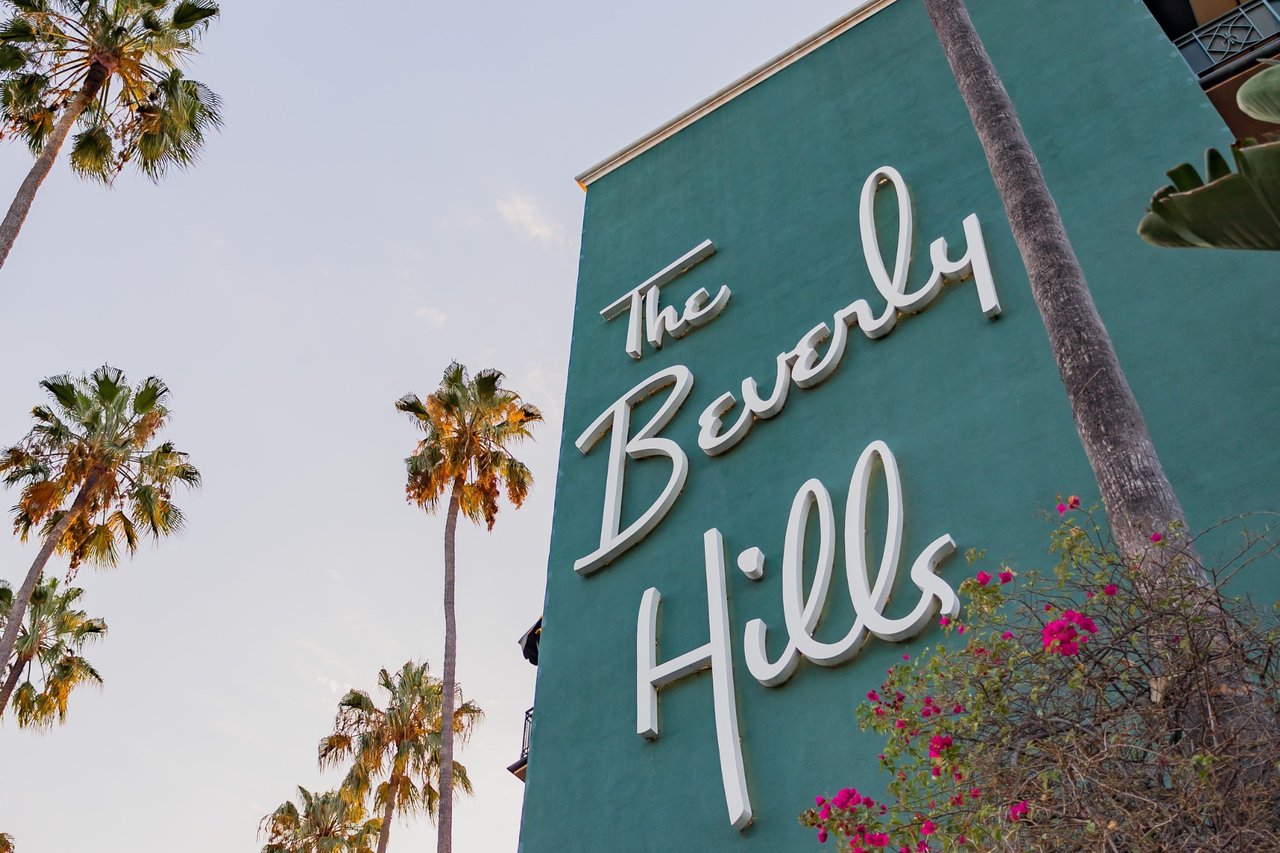
If you’ve been to Los Angeles, you’ve most likely been to—or at the very least seen—a structure designed by Williams. From the 1920s until his retirement in 1973, he was arguably the most prolific architect in California: He was part of the team that designed the Theme Building, the Space Age structure in the center of the Los Angeles International Airport. He did the Polo Lounge, Fountain Coffee Room, and Crescent Wing of the Beverly Hills Hotel. In fact, it’s his handwriting on the sign on the iconic pink-and-green exterior.
He designed the interiors—and later an expansion—of Saks Fifth Avenue on Wilshire Boulevard, the Los Angeles Superior Courthouse, and the Golden State Mutual Life Insurance Building. He undertook the massive renovation of the Beverly Wilshire Hotel.
Williams designed about 3,000 buildings. Some civic. Some commercial. Many residential—Williams built grand estates for Hollywood stars like Frank Sinatra, Lucille Ball, Bill Robinson, and Cary Grant, as well as powerful figures like Jay Paley, a member of the Paley family who founded the Columbia Broadcasting System (CBS), and chairman of Motion Pictures Producers and Distributors of America Will H. Hays. It earned him the nickname of “architect to the stars.” These stately homes were snapped up by the next generation of industry players at staggering sums: The late Barron Hilton, for example, bought Paley’s Bel Air home in the 1960s for $475,000 ($5.3 million in 2026 dollars). In 2021 his estate sold it for $61.5 million. In February the more-than-13,000-square-foot Beverly Hills estate designed for the mayor and sold to Gone With the Wind actor Ann Rutherford hit the market for around $40 million.
“I always like to say you could be born in a hospital designed by Williams, get married in a church designed by Williams, live in a home designed by Williams, go to a school designed by Williams, and then when you die, have your funeral in a Williams design funeral home,” says Staci Steinberger, a decorative arts and design curator at LACMA.
It’s a CV that would earn anyone a mention in the annals of history. “Paul Williams is one of the most prolific American architects, period. I would set his body of work alongside Frank Gehry and Thom Mayne,” says Milton S. F. Curry, senior associate dean at Cornell University. But when you factor in that Williams was the first licensed Black architect west of the Mississippi? Then he becomes a great, and unsung, figure of history. “He was an African American and doing such amazing work during the time where African Americans weren’t recognized for their brilliance,” Pauletta Washington says. “I felt special living in that house. I felt that he designed it for us.”
“I don’t think he’s celebrated nearly enough,” Rick Caruso, multibillionaire real estate developer and former Los Angeles candidate for mayor, tells me as he drives through Malibu.
Now, however, that’s changing. This summer through fall, three museums across the city—the USC Fisher Museum of Art, the Getty Research Institute, and LACMA—will have exhibits dedicated to Williams. USC’s will focus on his public housing sector projects, whereas the Getty examines his work through the lens of racial exclusion. LACMA, meanwhile, will offer a comprehensive retrospective across 8,000 square feet in the Resnick Exhibition Pavilion.
“Paul Williams was designing based upon the aspirational success of a rising class of wealthy Americans who wanted to manifest their wealth, their success, and the American dream. And the American dream in Los Angeles was a Paul Williams house,” Darren Walker says.
“His homes and his buildings should be landmarked,” Caruso says. “I don’t think people should be allowed to take him down.” If Williams has a superfan, it’s Caruso. He posts odes to him on Instagram. He attends galas for his estate. He’s struck up a sincere friendship with Karen E. Hudson, Williams’s granddaughter and the family historian, and often looks to Williams’s work as he builds mega-developments across Southern California.
Caruso’s five-star resort at Rosewood Miramar Beach includes a staircase similar to one of Williams’s and a pool with serpentine edges that’s inspired by the one Williams built for a Palm Springs resort. For The Grove, he studied the height of Williams’s windows. After the Palisades Village suffered major damage during the 2025 fire and Caruso began the massive logistical undertaking of rebuilding it, he once again looked to the work of Williams.
If Caruso is the president of the Williams fan club, Darren Walker, former president of the Ford Foundation and current CEO of Anonymous Content, is his vice president. This year the New Yorker found himself with a new job at the Los Angeles–based production studio. He didn’t have any plans to buy in the city at first. But then he was introduced to Jenna Cooper, the It LA real estate broker known for her architecturally significant listings. “She said, ‘There’s a house that you should own.’ I said, ‘I’m not interested in buying a house in LA. I have an apartment in New York,’ ” Walker recalls.
But Cooper insisted. Had he heard of Paul R. Williams?
Walker had. Did she want to show him a Williams house? No, she said. She wanted to show him the Williams house.
“I always like to say you could be born in a hospital designed by Williams, get married in a church designed by Williams, live in a home designed by Williams, go to a school designed by Williams, and then when you die, have your funeral in a Williams design funeral home,” says LACMA’s Staci Steinberger.
In the late 1940s, a series of court decisions saw more Black Los Angeles families move into neighborhoods such as Lafayette Square, an upper-middle-class enclave in Mid-City. Williams bought one of the last lots available.
Unburdened by the expectations of a client, he made something to his exact liking: a four-bedroom international-style home with a paneled door and lush landscaping—one of the few houses Williams ever built in the style. Inside was a formal entryway and a lanai—oh how Williams loved light—a stone fireplace, and a breakfast nook. For Della Mae, his beloved wife, he built the lanai, who fell in love with the indoor-outdoor rooms after a trip to Jamaica. He built a towering spiral staircase with galloping brass gazelles. Walker felt moved. This home needed a steward. And if not him, who? So he bought it. “He was a remarkable man. I feel so responsible for this important property of American heritage. Not just Black heritage. Of American heritage.” (He’s not the only one touched by the home: Solange Knowles staged an exhibit for her glassware practice, Saint Heron, there—not far from that gazelle staircase. “On paper that sounds far-out,” she says. “But in reality, the elegance in the expression was always so timeless, yet ahead of its time.”)
Over on Sunset Boulevard, designer Ken Fulk is busy expanding the Beverly Hills Hotel. He’s possibly the biggest name to do so since Williams himself. Every time he walks in, Fulk gazes upon his work. It’s “ballsy,” Fulk says. At the time, the hotel was a traditional Mediterranean-style building. Williams infused it with accents of the then contemporary midcentury-modern style as well as its now iconic pink-and-green color scheme—design elements that might have raised eyebrows among the traditional polo-playing residents of Beverly Hills. And he did it all while not being allowed to stay, eat, or swim at the hotel. “Fear is the enemy of good design,” says Fulk. “For somebody who might’ve had all the reasons to be afraid of heroic design, he wasn’t. He really made these lasting impressions, and representation, and fantasy of what life in Los Angeles could, should, would be. I think a lot of us see it through his eyes.” Fulk then assures me he isn’t touching the Fountain Coffee Room or the Polo Lounge. “Sacrosanct,” he says.
Williams has a story that, if not told to me by Hudson, his granddaughter, might at first seem to be a myth. He was born on February 18, 1894, in Downtown LA. His parents had moved to the city from Memphis not for a better life but a chance of having one: Both had tuberculosis. They went to California during the health rush of the 1890s, when hundreds of thousands of people suffering from severe ailments fled to warmer, drier weather in hopes that their symptoms would improve. They succumbed to TB by the time Williams was four. A member of the family’s church took him in and raised him.
At the time, sparsely settled Los Angeles was a land of relative possibility for a person of color. Unlike in the violently segregated Jim Crow South, Williams—who arrived well before the second great migration of the 1940s—found himself living in a multicultural neighborhood of Japanese, European, and Mexican immigrants, who were all trying to figure out a new life upon these vast stretches of sunny lands. (“In his own notes he wrote about learning conservation and planting and growing things from the Japanese kids in the neighborhood,” Hudson tells me. “I don’t think he ever forgot anybody he ever met.”) At age five, he got his first job selling newspapers at a stand on the corner of First and Spring. As a teenager, he attended the highly selective Polytechnic High School in Los Angeles. There, he expressed interest in architecture. A teacher, however, advised him against it: The Black community, they said, wouldn’t be able to afford an architect. White people, meanwhile, would never hire him. “You have ability—but use it some other way. Don’t butt your head futilely against the stone wall of race prejudice,” the teacher told him.
Williams could build homes in neighborhoods like Bel Air and Beverly Hills, but he couldn’t live there.... He could renovate and expand the Beverly Hills Hotel but wasn’t allowed to stay or eat there, unless he ate with the owner.
“Architecture, especially at the time that Williams was getting his start around the 1910s, was a largely white and white-collar profession. Architecture requires a great deal of capital to build. You need a base of clients. So this is always going to align itself almost naturally and unfortunately with systems of oppression and structures of power,” says Gary Riichiro Fox, assistant architecture curator at the Getty Research Institute, which this December will open “Paul R. Williams: Architecture Across the Color Line,” an exhibit that focuses on Williams’s groundbreaking work in the Black community. “The profession requires you to network with these other established architects. You have to get their support for your application to become a licensed architect. You have to get a certain number of hours of practice before you can call yourself an architect. This is to say that there’s so many different barriers to entry and gates that are kept that he [had] to really intentionally and with a great deal of savvy learn to navigate and work through and across.”
But Williams did. He entered a number of architectural competitions in which his race wasn’t disclosed. He won several of them—gaining notice from prominent area architects including John C. Austin, who built Griffith Observatory, and Reginald Davis Johnson, who took him on as an apprentice. He studied at, among several schools, the Beaux-Arts Institute of Design and USC’s School of Engineering, concluding his education in 1919. Throughout his studies, he worked. Afterward, he flipped through the yellow pages looking for jobs. And when he found a listing? “He got dressed up and put on his church clothes. He had a little portfolio that he carried with him, and he’d go door-to-door and knock on them and ask him if they were hiring,” says Hudson. Throughout his life, Williams became known for his impeccable sense of dress.
In 1921 he became a licensed architect just as Los Angeles itself became a boomtown. Suddenly, Williams’s skill set became desperately needed. One of his first major clients? The president of Los Angeles Investment Company and US senator Frank Putnam Flint, who was planning a 1,700-acre residential development outside of Pasadena—and who was a regular customer at Williams’s paper stand. He designed more than 30 homes for Flint’s project, including one for Flint himself in the style of a Southern governor’s mansion. That quickly led to a job for another high-profile Angeleno, a 12,000-square-foot Tudor revival house purchased by horse breeder Jack P. Atkin in 1929 for $500,000, or about $10 million today. (It was so grand that it was featured in the Cary Grant film Topper and, later, Murder, She Wrote.)
To borrow a phrase Atkin likely used himself, then it was off to the races. Through the next two decades, the rich and famous of LA all wanted the grand mansions that Williams could provide. It became a status symbol: “Paul Williams was designing based upon the aspirational success of a rising class of wealthy Americans who wanted to manifest their wealth, their success, and the American dream. And the American dream in Los Angeles was a Paul Williams house,” Walker says.
While some architects refused to venture beyond a certain aesthetic, Williams could build a Georgian, Spanish revival, ranch, or midcentury-modern home—whatever the client preferred. The things his designs always had in common, however, were plenty of natural light, high ceilings, curved staircases, and a breakfast room that faced the morning sun.
Up to this point, Williams’s story may sound like a fairy tale. It wasn’t. The truth is that while Los Angeles was considered progressive for its time, progress had limitations. Williams could build homes in neighborhoods like Bel Air and Beverly Hills, but he couldn’t live there. (The Supreme Court didn’t rule that racial deed restrictions couldn’t be enforced until 1948 in Shelley v. Kraemer, and it took the 1968 Civil Rights Act to prohibit discrimination in the sale, rental, and financing of housing.)
He could renovate and expand the Beverly Hills Hotel but wasn’t allowed to stay or eat there, unless he ate with the owner. Hudson says her grandfather shook white clients’ hands only if they offered them first. He learned to draw upside down—both as an impressive gimmick to charm potential customers but also in case they didn’t feel comfortable sitting next to him. If someone walked into his office and looked shocked that he was Black, he would ask their budget. When they gave him a number, he responded that he didn’t work on projects with that low of a price. “They’d be like, ‘Excuse me?’ Let me just stay here and talk to you because obviously there’s something I don’t know,” Hudson says.
In 1937, Williams penned an essay for The American Magazine titled “I Am a Negro.” “Today I sketched the preliminary plans for a large country house which will be erected in one of the most beautiful residential districts in the world, a district of roomy estates, entrancing vistas, and stately mansions. Sometimes I have dreamed of living there. I could afford such a home,” he wrote. “But this evening, leaving my office, I returned to my own small, inexpensive, home in an unrestricted, comparatively undesirable section of Los Angeles, [because]...I am a Negro.”
Williams also dedicated much of his life to making those undesirable sections less so. He built for Black families and the community: like the 28th Street YMCA in South Los Angeles, the midcentury house he designed for J. Phyromn Taylor in Lafayette Square, or the First African Methodist Episcopal Church by USC. He even built and served in a leadership role at Broadway Federal Savings and Loan, which gave loans to Black families who weren’t traditionally allowed at white financial institutions. “Black folks couldn’t get home loans because of restrictive covenants and because they were Black. People were coming home from the war. For my grandfather, it was the realization that without homeownership, our communities could not survive,” Hudson says.
Yet white clients were allowed at his institution: When Pierre Koenig wanted to build a steel-and-glass midcentury-modern house cantilevered over the Hollywood Hills for his clients Buck and Carlotta Stahl, no bank would give them a loan. So Koenig went to Williams, hoping the fellow architect would understand his vision. He did. Today, the Stahl House is considered an architectural masterpiece and listed on the National Register of Historic Places.
This is a highly ethical person and a person who cared deeply about his community and the culture that nurtured him to become who he was. He was an architect and also a Black architect.
Hudson says that’s just the kind of guy her grandfather was: “When you think about it, how many architects would do something to help publicize the work of another architect?” Especially when his own work wasn’t necessarily getting the recognition it deserved: While his contemporaries like Koenig and Richard Neutra received critical and cultural acclaim, Williams’s work wasn’t often viewed through such an artistic lens. Part of it was because Williams designed what his clients wanted rather than adhering to a strict aesthetic code, so he wasn’t considered an avant-garde architect. (“To be sincere in my work, I must design homes, not houses,” he once wrote.) And part of it was just...the time.
Today his legacy is so commonplace, it’s often ignored. Much of Williams’s work, like the Paley house, features painted brick in a monotone color—what Caruso calls tone on tone. “People may think that that’s like no big deal. But that is a big deal! Because you have to draw something to hold its own in order to have everything sort of in a relatively monotone color,” he says. The rebuilt Palisades Village will be much in the same vein. “I’m a guy that started my own business. I respect people that start with nothing and build something up—and hopefully maintain your integrity and determination throughout your career. From what I’ve read about him, he’s done that. And didn’t complain as far as I know about the odds that were against him. He put his head down and he just became the best at it. That’s a great lesson.”
Williams died in 1980 at the age of 85. He couldn’t see because of his glaucoma and wasn’t always sure who, or where, he was. Yet during those final years, his family always used to take him on Sunday drives. Every time, they passed by the old MCA Headquarters on North Crescent Drive. He looked at the grandiose Georgian structure, with its sky-high white pillars and formal gardens that stretched a city block. “That’s a fine piece of work,” he said. They hoped he knew he designed it.